AI for Business in Dubai & UAE: The Complete 2026 Guide
AI is changing how businesses across Dubai and the UAE handle customer enquiries, sales, support and everyday operations. This complete guide explains how AI agents, voice AI, CRM integration and business automation can be used practically to improve efficiency and customer experience.

Artificial intelligence is moving rapidly from experimentation into everyday business operations.
Across Dubai and the wider UAE, businesses are exploring how AI can help them answer customer enquiries faster, manage leads more effectively, automate repetitive work, improve customer service and give employees more time to focus on higher-value activities.
But adopting AI should not simply mean adding another piece of software.
The real opportunity comes from identifying where customers are waiting, where employees are repeating the same tasks, where leads are being lost and where disconnected systems are slowing the business down.
AI can then be introduced into those processes in a practical and measurable way.
For some companies, that may start with an AI receptionist answering missed calls. For others, it could mean automating sales follow-ups, connecting AI with a CRM, improving customer support or deploying AI agents capable of completing multi-step tasks.
This guide explains the main ways businesses in Dubai and the UAE can use AI and how these technologies can work together as part of a connected business system.
Why AI Matters for Businesses in Dubai and the UAE
The UAE has made artificial intelligence an important part of its long-term technology and economic strategy.
The UAE Strategy for Artificial Intelligence was launched in 2017 with objectives including improved government performance, smart digital systems and encouraging AI investment across multiple sectors.
Dubai has taken this further through the Dubai Universal Blueprint for Artificial Intelligence, which is designed to accelerate AI adoption across strategic sectors and support the goals of the Dubai Economic Agenda D33.
For individual businesses, however, AI adoption does not need to begin with a large transformation programme.
It can begin with a much simpler question:
Where is our business losing time, customers or opportunities because a process is still manual?
That might include unanswered calls, slow enquiry responses, forgotten sales follow-ups, repetitive administration, disconnected customer information or employees repeatedly entering the same information into different systems.
These are often the areas where practical AI and automation can make the greatest difference.
What Does AI for Business Actually Mean?
AI for business means using artificial intelligence to assist, improve or automate tasks within a company’s operations.
This can range from a relatively simple AI assistant helping employees find information to sophisticated AI agents capable of interacting with customers, using business software and completing multi-step workflows.
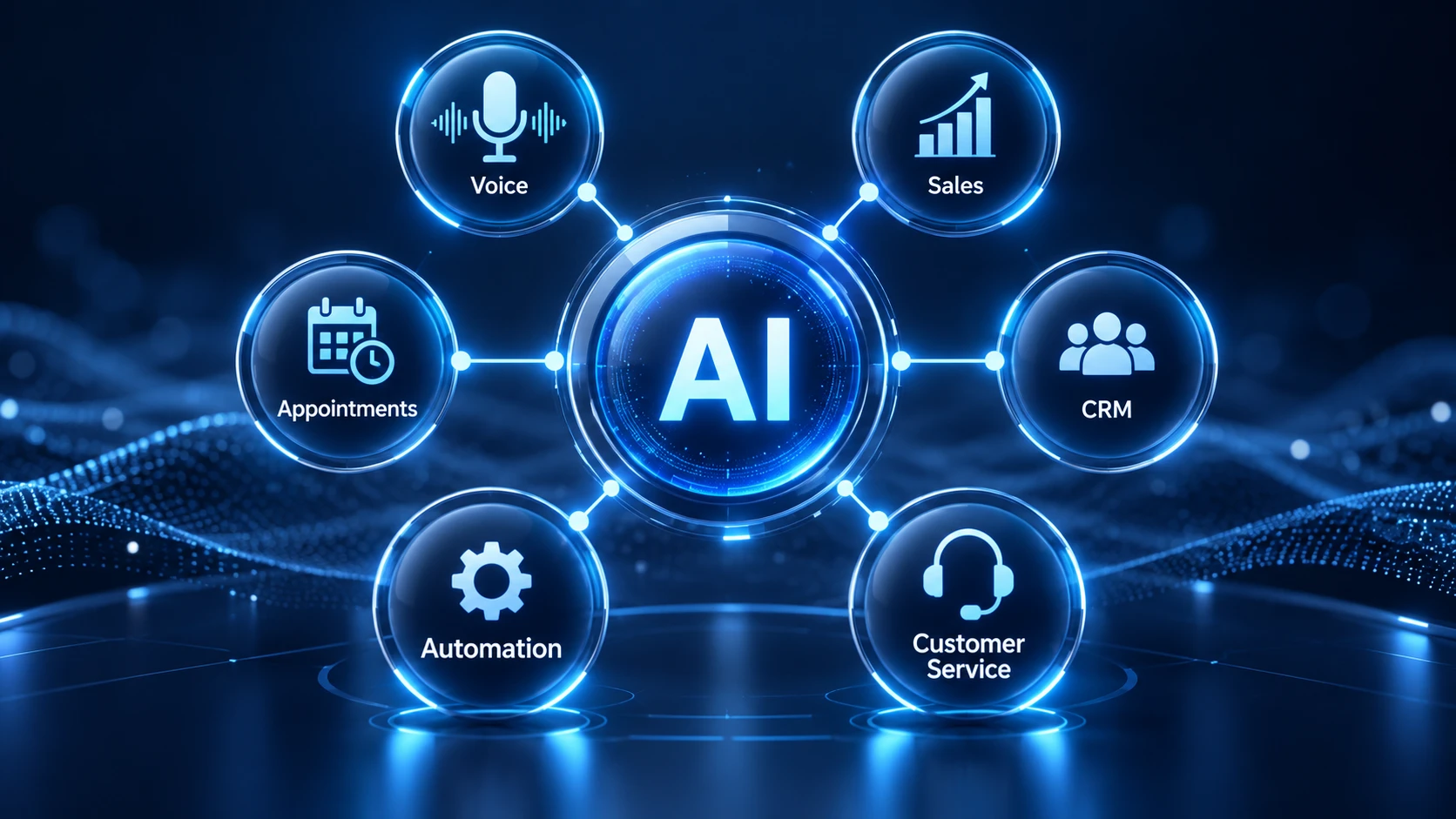
Modern AI can work across:
- Phone calls
- Websites
- Customer service
- Sales processes
- CRM systems
- Messaging
- Appointments
- Internal workflows
- Data and reporting
- Marketing
- Administration
The important distinction is that AI becomes considerably more valuable when it is connected to the systems where work actually happens.
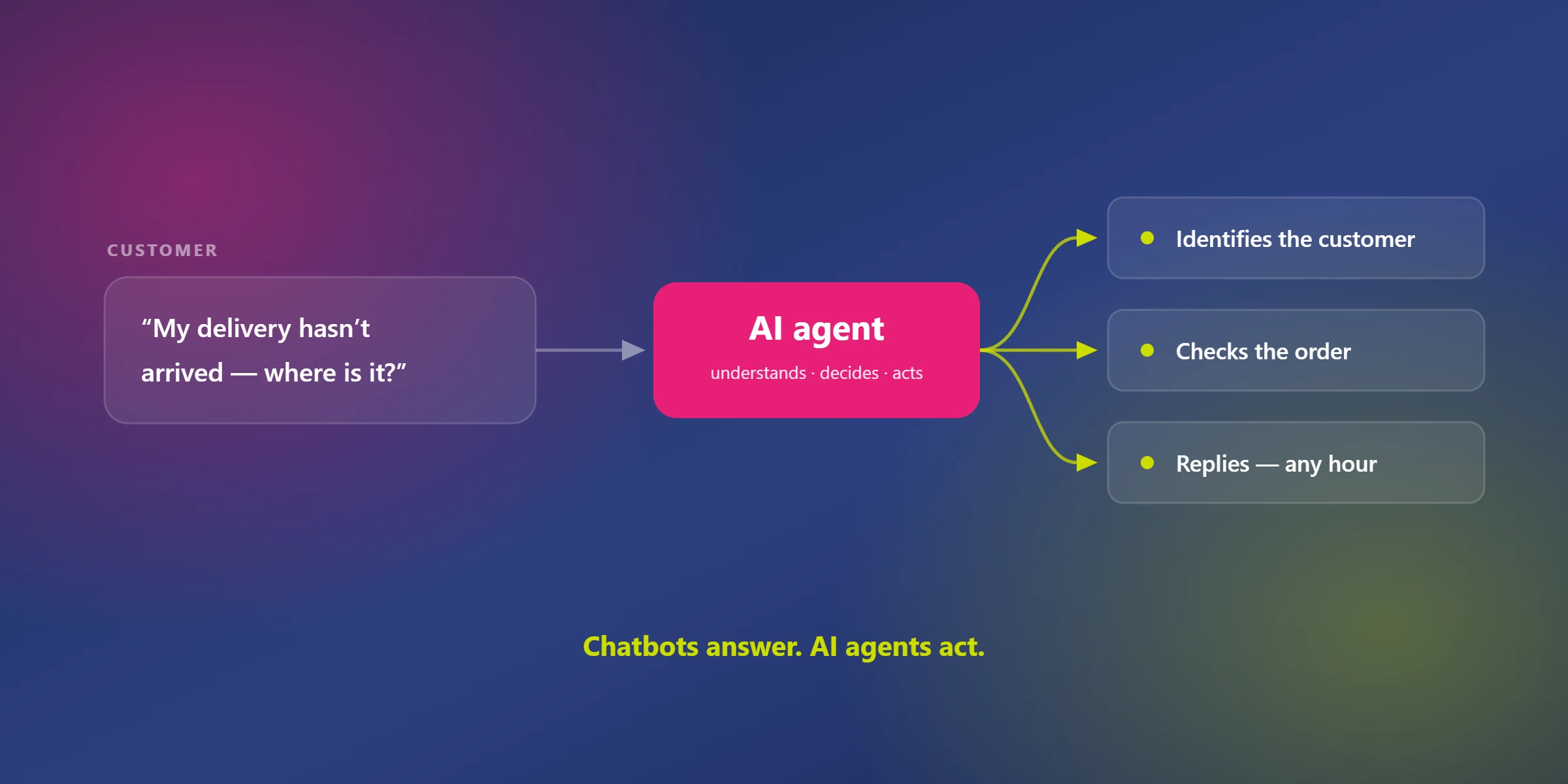
An isolated chatbot may answer a question.
A connected AI system may answer the question, recognise the customer, update the CRM, schedule an appointment, notify the appropriate employee and create the next follow-up automatically.
That is the difference between simply using AI and building an AI-enabled business process.
1. AI Voice Agents
Phone conversations remain an important part of doing business in many industries.
The difficulty is that businesses cannot always have someone available to answer every enquiry immediately.
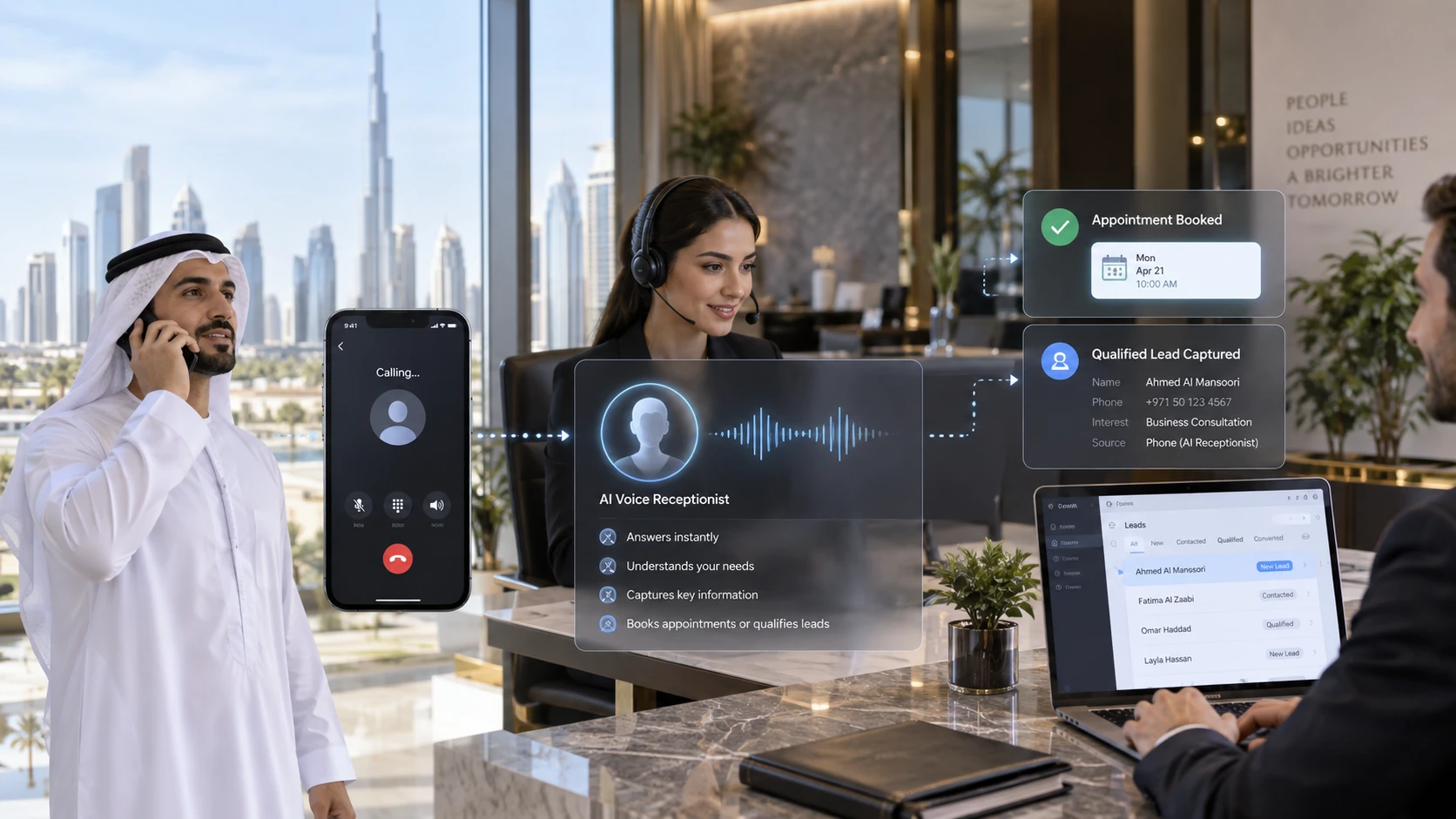
An AI voice agent can conduct natural-language telephone conversations and perform approved tasks based on the company’s requirements.
Depending on how the system is configured, an AI voice agent may be able to:
- Answer incoming enquiries
- Make approved outbound calls
- Identify why a customer is calling
- Capture customer information
- Qualify enquiries
- Book appointments
- Confirm bookings
- Answer frequently asked questions
- Update the CRM
- Trigger follow-up actions
- Escalate conversations to an employee
For example, imagine that a prospective customer calls a Dubai business after normal operating hours.
Instead of reaching voicemail, the customer speaks with an AI voice agent.
The AI identifies what the customer needs, collects the required details, records the enquiry and schedules the appropriate next step.
When the sales team returns, the opportunity is already documented rather than sitting inside a missed-call notification.
For businesses that receive significant telephone enquiries, this can provide a useful additional layer around the existing team.
2. AI Receptionists
An AI receptionist is closely related to voice AI but is generally focused on handling incoming customer interactions.
It can become the first point of contact for routine enquiries while providing an escalation path when human assistance is necessary.
An AI receptionist could help with enquiries relating to:
- Business hours
- Service information
- Appointment requests
- Availability
- Customer details
- Call routing
- Frequently asked questions
- Lead capture
- Basic customer support
This is particularly useful for businesses where employees are frequently away from the telephone.
A trades company, for example, may have technicians working on-site.
A property business may have agents attending inspections.
A medical practice may have reception staff assisting patients in person.
The objective is not necessarily to remove the existing receptionist or customer service team.
Instead, AI can help ensure that routine enquiries continue to be handled when employees are busy.
3. AI Sales Agents
One of the biggest challenges for sales teams is not necessarily generating enquiries.
It is responding to every enquiry quickly and following each opportunity consistently.
A salesperson might receive website enquiries, telephone calls, emails, referrals and messages throughout the day.
Some leads receive an immediate response.
Others are followed up later.
Some may never receive the second or third follow-up that could have converted them into customers.
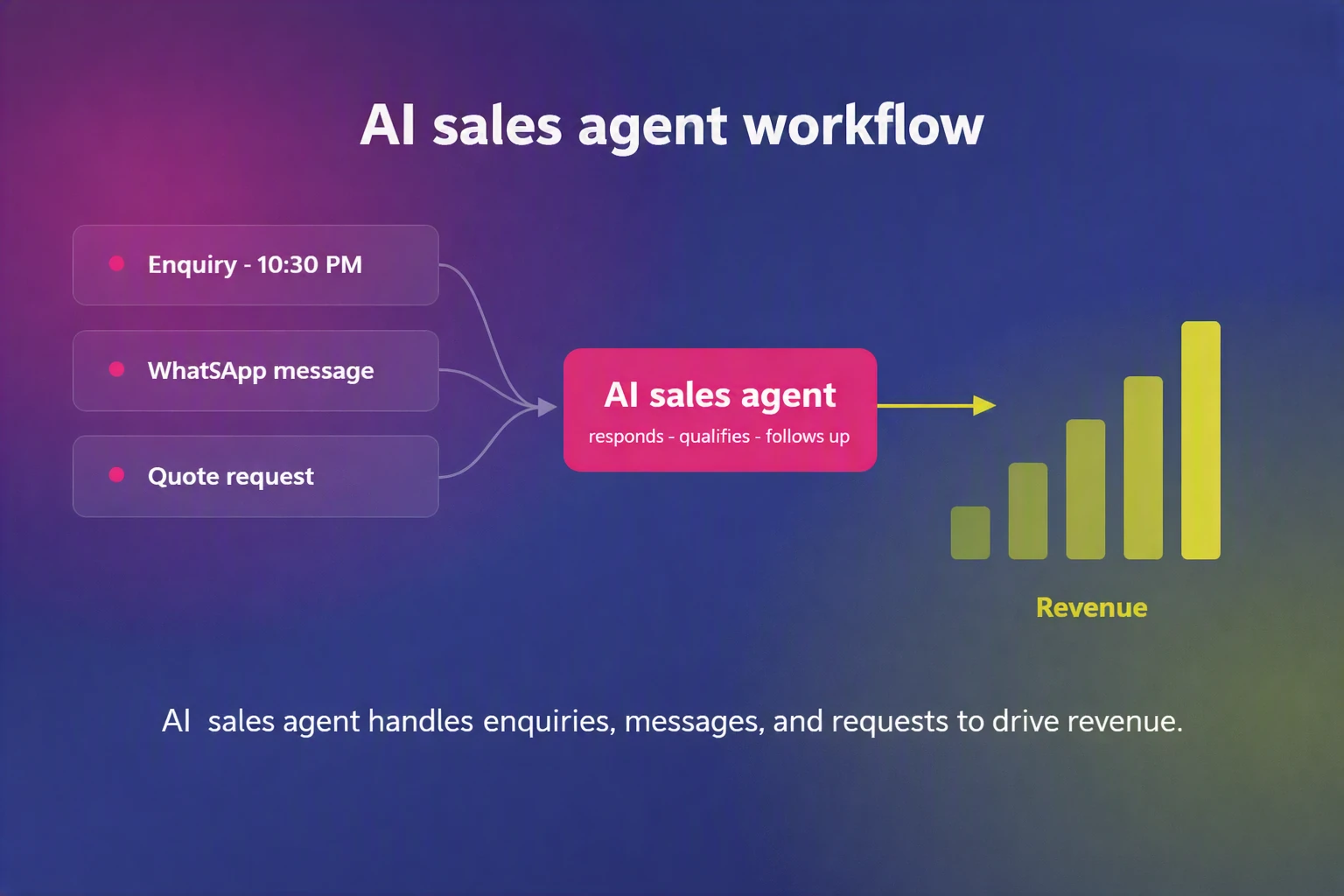
AI sales agents can assist with the early and repetitive stages of this process.
A typical workflow could look like this:
AI can help collect information such as what the customer needs, location, timeframe, budget or other qualifying details relevant to the business.
It can then ensure that this information enters the sales process consistently.
The salesperson remains responsible for the conversations where experience, negotiation, trust and judgement matter most.
AI supports the process around them.
4. AI Customer Service
Customer expectations have changed considerably.
People increasingly expect quick access to information rather than waiting hours or days for a response.
AI customer service systems can help businesses respond to common customer enquiries while escalating more complex situations to employees.
AI can potentially assist with:
- Frequently asked questions
- Service information
- Booking changes
- Order or request status
- Initial troubleshooting
- Customer identification
- Support classification
- Ticket creation
- Request routing
- Knowledge-base retrieval
This can be useful both for customers and employees.
Rather than spending a large part of the day answering the same questions repeatedly, customer service teams can focus on situations where human judgement and personal attention provide greater value.
AI can also help prepare information before a case reaches an employee.
Instead of receiving an enquiry with no context, the employee may receive a summary of the conversation, the customer’s details and the reason for escalation.
5. AI Agents and Agentic AI
Traditional automation generally follows predetermined rules.
For example:
AI agents can go further.
An AI agent can be designed to work toward a defined objective, interpret information, choose appropriate actions and interact with approved tools.
For example, an AI sales agent could potentially:
Research a prospect, review CRM history, determine whether a lead meets qualification criteria, prepare a response, create a CRM activity and schedule a follow-up.
Another agent may focus on customer service.
Another might support finance, marketing, operations or internal administration.
More advanced implementations can involve several specialised AI agents working together.
This broader movement toward Agentic AI is particularly relevant for businesses that want to automate complete workflows rather than individual tasks.
6. AI + CRM: Where AI Becomes Much More Useful
One of the most valuable connections for business AI is the CRM.
Without CRM integration, businesses can still end up with disconnected systems.
An AI assistant may speak with a customer, but an employee then has to manually enter everything into the CRM.
That removes much of the efficiency that automation was meant to create.
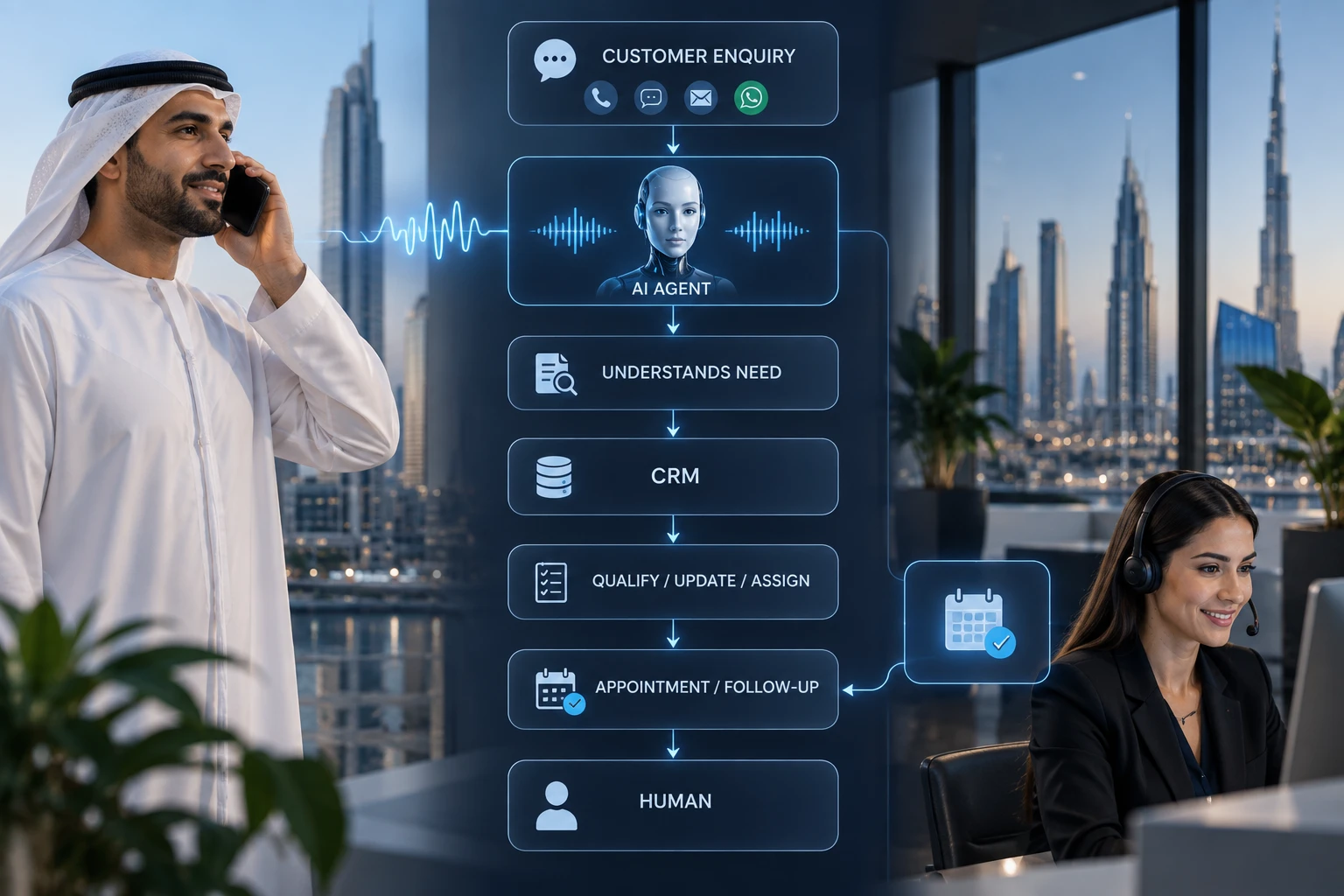
A connected workflow can be very different.
- A customer contacts the company.
- The AI identifies the customer or creates a new contact.
- The reason for the enquiry is recorded.
- The opportunity is classified.
- Relevant notes are added.
- The correct salesperson is assigned.
- An appointment or task is created.
- The next follow-up is scheduled.
Management can then see the entire activity inside the CRM.
This creates a connected customer journey rather than another isolated technology platform.
7. Business Process Automation With AI
Not every business problem requires an AI agent having a conversation.
Many processes simply need better automation.
AI and workflow automation can help businesses reduce repetitive administration across multiple departments.
Lead Management
A new enquiry can automatically enter the CRM, be assigned to the appropriate employee and trigger the correct follow-up sequence.
Appointment Management
A customer can request an appointment, check available times, confirm the booking and receive reminders automatically.
Sales Follow-Up
An opportunity that has not been contacted within a specified timeframe can trigger an alert or automated follow-up.
Customer Service
Requests can be classified and routed based on their subject, urgency or customer type.
Invoice and Payment Follow-Up
Businesses can automate approved reminders and internal notifications around outstanding invoices.
Internal Administration
Completing one business task can automatically generate the next task and notify the appropriate employee.
Each automation may save only a few minutes individually.
Across hundreds or thousands of activities, the impact becomes much more significant.
8. AI Across the Customer Journey
Businesses do not necessarily need to think of AI as a single product.
It can support different parts of the customer journey.
Discovery
AI can help visitors navigate services and find relevant information.
Enquiry
AI voice and digital assistants can respond when a potential customer contacts the business.
Qualification
AI can collect information and determine what type of opportunity has been created.
Appointment
Scheduling can happen without repeated communication between the customer and staff.
Sales
AI can assist with CRM updates, reminders and follow-up workflows.
Customer Service
Routine questions can be handled while complex cases are escalated.
Retention
Customers can receive timely communication, reminders and follow-ups based on their activity.
The larger opportunity appears when these stages connect.
Instead of separate systems for sales, telephone calls, CRM and customer service, AI can help information move between them.
9. Where Can UAE Businesses Use AI?
AI is not limited to technology companies.
Its applications depend more on the workflow than the industry.
Real Estate
AI can help property businesses handle enquiries, qualify buyers and tenants, arrange inspections, respond to common questions and keep CRM information updated.
Healthcare and Medical Practices
AI may assist with administrative enquiries, appointment scheduling, reminders and call routing, subject to the privacy, security and regulatory obligations relevant to the organisation.
Trades and Service Businesses
Service businesses can use AI to capture missed calls, identify the required service, collect location details, arrange appointments and follow up quotes.
Professional Services
Consultants and professional firms can use AI for initial enquiries, consultation bookings, information collection and lead qualification.
Hospitality
Restaurants, hotels and hospitality businesses can use AI around reservations, general enquiries, booking confirmations and customer requests.
Retail and E-commerce
AI can assist with product questions, customer service, order enquiries and personalised interactions.
The right AI use case therefore depends less on the industry name and more on the repetitive processes that exist inside the business.
10. AI Should Work With Your Team, Not Around Your Team
AI adoption is sometimes discussed as though businesses have only two choices: people or technology.
That is rarely the most useful way to look at it.
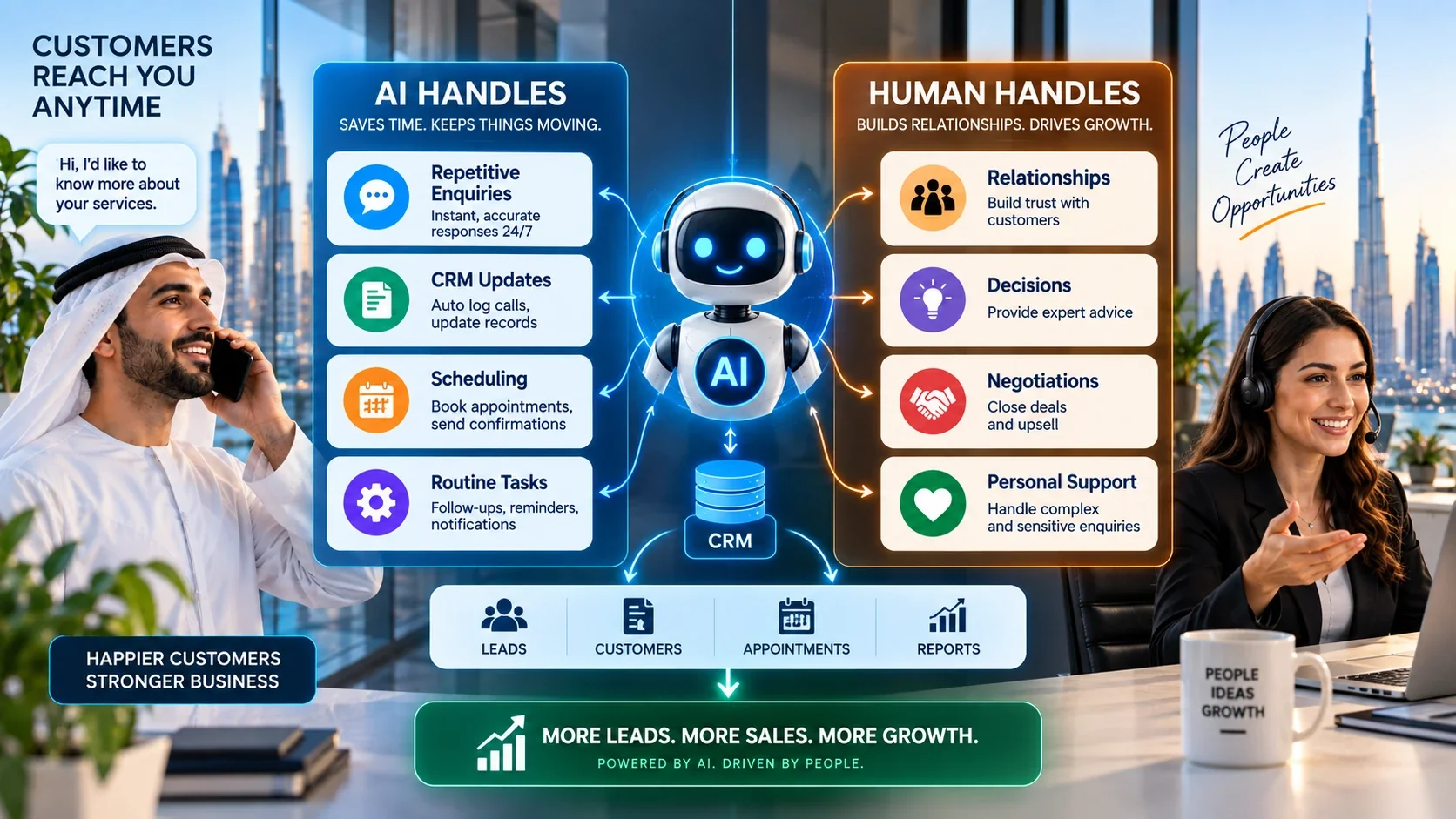
There are many situations where AI can handle repetitive processes efficiently while people remain essential for relationships, judgement and complex decision-making.
AI is particularly suited to tasks such as repetitive enquiries, information capture, scheduling, reminders, CRM updates and process triggering.
Employees remain particularly important for complex customer situations, negotiations, relationships, unusual circumstances, strategic decisions and sensitive matters.
A practical AI strategy therefore asks:
What should technology handle, and where does human involvement create the most value?
The objective should be to make the business more responsive without making the customer experience less personal.
11. Start With the Business Problem, Not the Technology
A common mistake is beginning an AI project by asking:
“Which AI platform should we buy?”
A better place to start is with the operational problem.
For example:
- “We miss too many customer calls.”
- “Our team takes too long to respond to new enquiries.”
- “Salespeople are spending hours entering CRM information.”
- “Our follow-up process is inconsistent.”
- “Customers repeatedly contact us with the same questions.”
Once the problem is clearly understood, it becomes much easier to determine whether AI, workflow automation or a simpler technology solution is appropriate.
Not every process needs AI.
The goal is not to automate the most things.
It is to automate the right things.
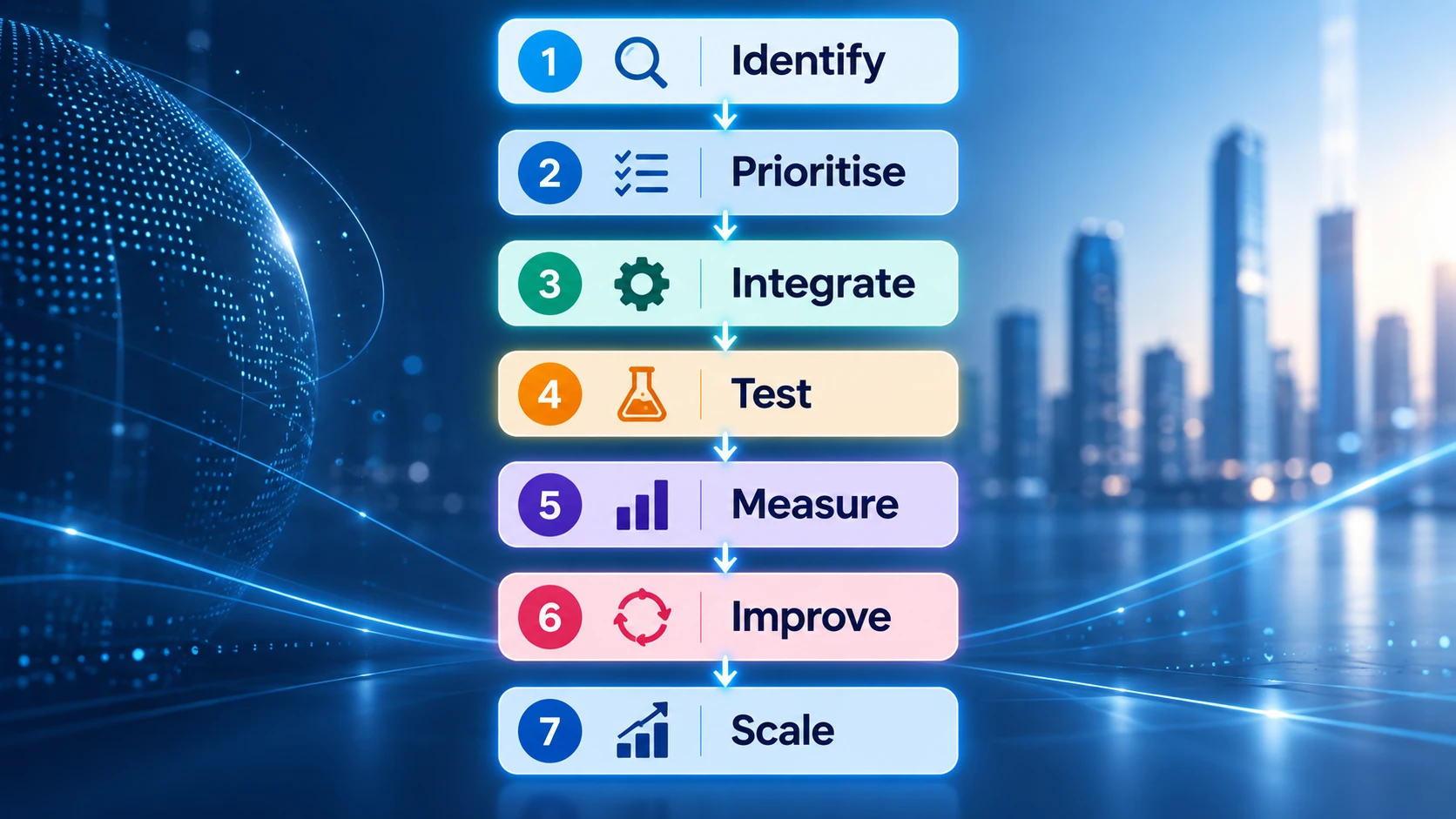
12. A Practical AI Implementation Roadmap
Step 1 — Identify Repetitive Work
Look at the activities employees perform every day and identify tasks that repeatedly consume time.
Step 2 — Identify Customer Friction
Find where customers experience delays, unanswered enquiries or unnecessary steps.
Step 3 — Look for Lost Opportunities
Review missed calls, neglected leads, slow follow-ups and incomplete CRM records.
Step 4 — Choose One High-Impact Process
Rather than attempting to automate the entire company immediately, select one workflow where the outcome can be clearly measured.
Step 5 — Identify Required Integrations
Determine which systems need to communicate.
This might include the telephone system, CRM, website, calendar, email or accounting platform.
Step 6 — Test the Customer Experience
Technology should make the customer’s experience easier.
Test the workflow from the customer’s perspective, not only from the technical side.
Step 7 — Measure the Result
Relevant measurements may include response time, enquiries handled, appointments booked, leads qualified, follow-ups completed and employee time saved.
Step 8 — Expand Gradually
Once one workflow is operating effectively, additional AI and automation can be introduced.
This staged approach usually provides much clearer visibility over what is delivering value.
13. Responsible AI, Privacy and Human Oversight
Businesses also need to consider how AI systems handle customer information and how decisions are made.
The UAE Charter for the Development and Use of Artificial Intelligence places emphasis on responsible AI, privacy, data security, transparency, accountability, safety and human oversight.
These principles are particularly important when AI interacts directly with customers or has access to business systems.
Companies should understand:
- What information the AI can access
- Where customer data is stored
- Which actions the system is allowed to perform
- When human approval is required
- How conversations and actions are logged
- How customers can reach an employee
- Which regulatory requirements apply to their industry
AI should not simply be connected to every system and given unlimited authority.
Permissions, escalation rules and human oversight should form part of the design.
14. AI Voice, CRM and Automation Work Better Together
The most useful business AI is often not a single product.
It is a connected workflow.
Imagine a potential customer calling a Dubai business.
- The AI voice agent answers.
- It understands why the customer is calling.
- It identifies whether the person already exists in the CRM.
- Relevant information is collected.
- The CRM is updated.
- An appointment is scheduled.
- The salesperson receives the details.
- A follow-up task is created automatically.
Every stage becomes part of one customer journey.
This is where AI begins moving from an interesting technology into practical business infrastructure.
15. What Should You Look for in a Business AI Solution?
Before implementing AI, businesses should consider whether the solution fits the way they actually operate.
Important areas include integration, customisation, escalation, security, reporting and ongoing support.
Integration
Can the AI connect with your CRM, website, telephone system and other important business platforms?
Customisation
Can the workflow reflect your processes rather than forcing your team into a generic model?
Human Escalation
Can customers reach an employee when the conversation requires one?
Permissions
Can you control what information and actions the AI is allowed to access?
Reporting
Can the business see what the AI is doing and measure its results?
Scalability
Can the system continue working as the company’s enquiry volumes and requirements increase?
Ongoing Improvement
AI implementation should not end on launch day.
Real conversations and real workflows reveal opportunities to improve the system over time.
16. The Future of AI for Businesses in Dubai
Dubai’s approach to AI indicates that artificial intelligence will continue becoming more deeply integrated into the emirate’s economy and business environment.
The Dubai Universal Blueprint for Artificial Intelligence specifically focuses on accelerating AI adoption, encouraging AI businesses and talent, and increasing the use of AI across strategic sectors.
For private businesses, however, success with AI will probably not come from adopting every new tool.
It will come from using AI deliberately.
- Answer the calls that are currently being missed.
- Follow up the leads that currently go cold.
- Remove repetitive administrative work.
- Connect the systems that currently operate separately.
- Give employees better information.
- Make the customer’s journey easier.
Then expand from there.
Businesses that approach AI this way can move from isolated experiments toward a more connected and efficient operating model.