31 August 2026
How AI Sales Agents Turn Missed Leads Into Revenue for UAE Businesses
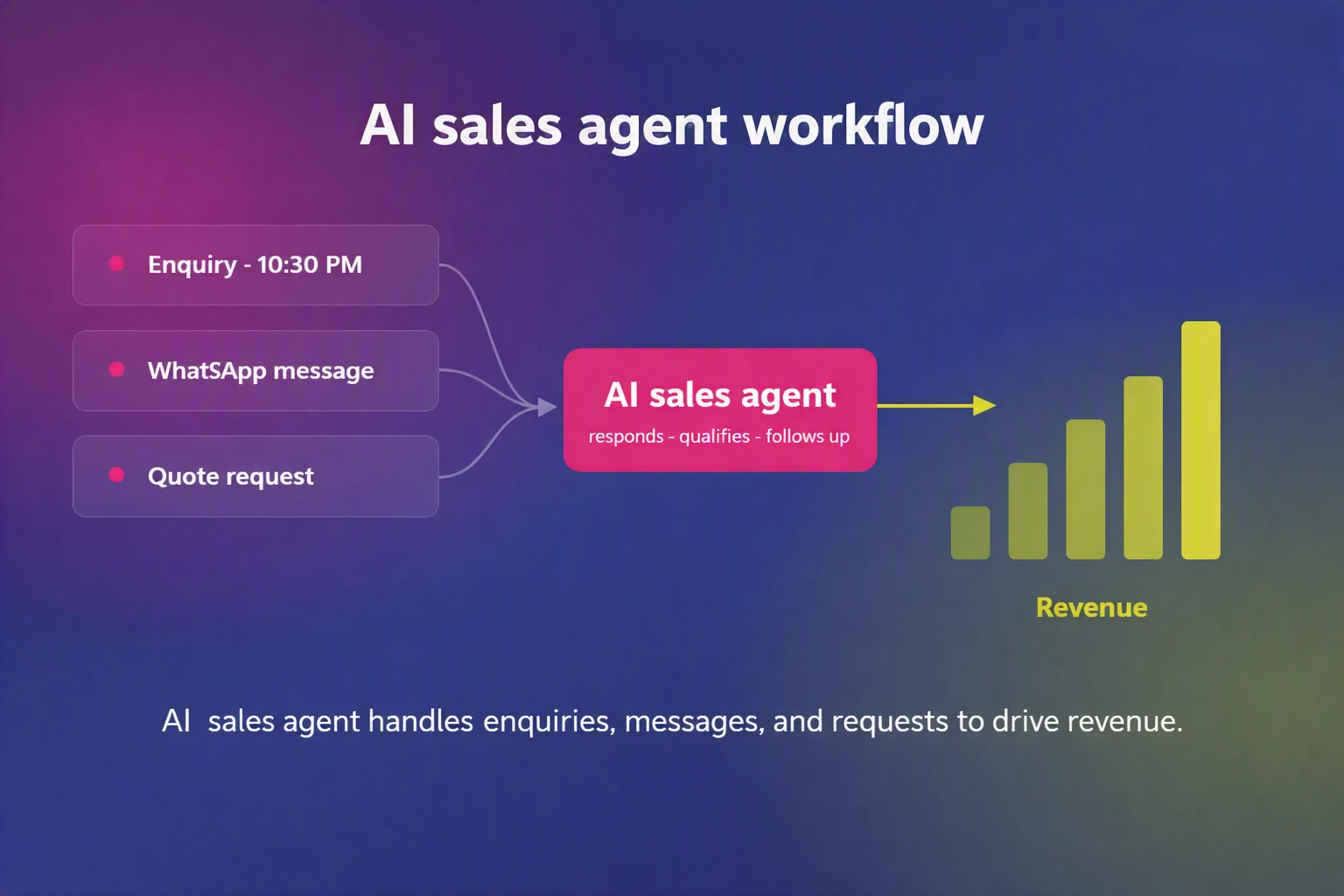
A potential customer submits an enquiry at 10:30 PM. Another sends a WhatsApp message while your sales team is busy. A third requests a quotation on Friday and does not hear back quickly enough.
By the time your team responds, the customer may already be speaking with a competitor.
For businesses in Dubai and across the UAE, the problem is often not generating leads. It is what happens after the lead arrives.
Slow responses, inconsistent follow-ups, forgotten enquiries and overloaded sales teams can quietly turn valuable opportunities into lost revenue.
This is where AI sales agents in the UAE are beginning to change the sales process.
Instead of simply storing leads or sending scheduled emails, AI sales agents can respond, qualify prospects, maintain conversations, update CRM records, schedule appointments and determine when a human salesperson should step in.
The result is a sales operation that does not stop when your sales team does.
The Hidden Cost of a Missed Lead
Businesses invest heavily in Google Ads, SEO, social media, websites, networking and other campaigns to generate enquiries.
But generating a lead is only the beginning.
Imagine a Dubai property services company receiving 100 enquiries in a month. Some arrive through its website, others through calls, WhatsApp, social media and advertising campaigns.
The sales team may respond quickly to most of them.
But what happens to the rest?
- Some receive a late response.
- Some are contacted once and forgotten.
- Some say, “Call me next month,” but nobody remembers.
- Others ask a question outside normal business hours.
- A few simply disappear inside the CRM.
Each one represents potential revenue that the company already spent money to acquire.
The problem therefore isn’t always lead generation.
It is lead conversion infrastructure.
What Is an AI Sales Agent?
An AI sales agent is an intelligent software agent designed to perform parts of the sales process autonomously.
Unlike basic automation that follows rigid instructions such as:
an AI agent can work towards an objective. For example:
Modern AI agents can interpret context, interact with business systems and complete multi-step tasks instead of waiting for a human to initiate every action.
That capability is what separates a scripted workflow from genuine AI agents for UAE businesses.
This shift towards autonomous AI is particularly relevant in the UAE. Dubai launched an initiative in 2026 designed to accelerate Agentic AI adoption across the private sector, with the stated objective of improving productivity and enabling new business models.
For sales teams, this creates an important opportunity: move from simply automating tasks to automating outcomes.
From New Lead to Sales Opportunity: What Happens Automatically?
Consider what happens when a prospect visits a company’s website and requests information.
1. The lead receives an immediate response
Instead of waiting for someone to open the CRM the next morning, an AI sales agent can begin the interaction immediately.
Depending on the company’s systems and customer permissions, that interaction could continue through:
- Website chat
- AI voice
- CRM messaging
- Other connected communication channels
The objective is not simply to send an automated “Thank you for contacting us” message.
The AI agent can begin moving the enquiry forward.
2. AI starts qualifying the lead
Not every enquiry deserves the same sales response.
A good sales agent needs to understand things such as:
- What does the prospect need?
- Where are they located?
- What is their budget?
- How soon do they need the service?
- Are they the decision-maker?
- Which service are they interested in?
- Is this a high-value opportunity?
- Does the enquiry meet the company’s sales criteria?
An AI lead qualification system can collect and analyse this information automatically.
Instead of salespeople spending the first part of every conversation gathering basic details, they can enter the conversation with considerably more context.
3. Every Lead Can Be Prioritised
One of the biggest problems with a busy sales pipeline is knowing who to contact first.
Ten new enquiries may arrive within an hour, but they are unlikely to have equal commercial value.
AI can analyse available lead information and assign priority based on factors defined by the business. For example:
Instead of relying entirely on chronological inbox order, sales teams can focus their attention where human involvement has the greatest potential impact.
4. Follow-Ups No Longer Depend Entirely on Memory
This is where significant revenue can disappear.
A salesperson speaks with a prospect. The prospect says: “Looks interesting. Contact me again next week.”
The salesperson intends to do it.
Then meetings happen. More leads arrive. Priorities change.
The follow-up is forgotten.
AI sales automation can change this.
The conversation, lead status and next action can be recorded automatically. When the appropriate time arrives, the sales workflow can restart.
But modern AI follow-up can go further than a generic: “Just following up on my previous email.”
The agent can use CRM context to create a more relevant interaction based on the prospect’s previous conversation, interests and stage in the sales journey.
That makes automation feel less like a scheduled sequence and more like a continuous sales process.
5. AI Can Work Across the CRM
AI becomes significantly more useful when it is connected to the systems where sales information already lives.
For example, an integrated AI sales workflow can:
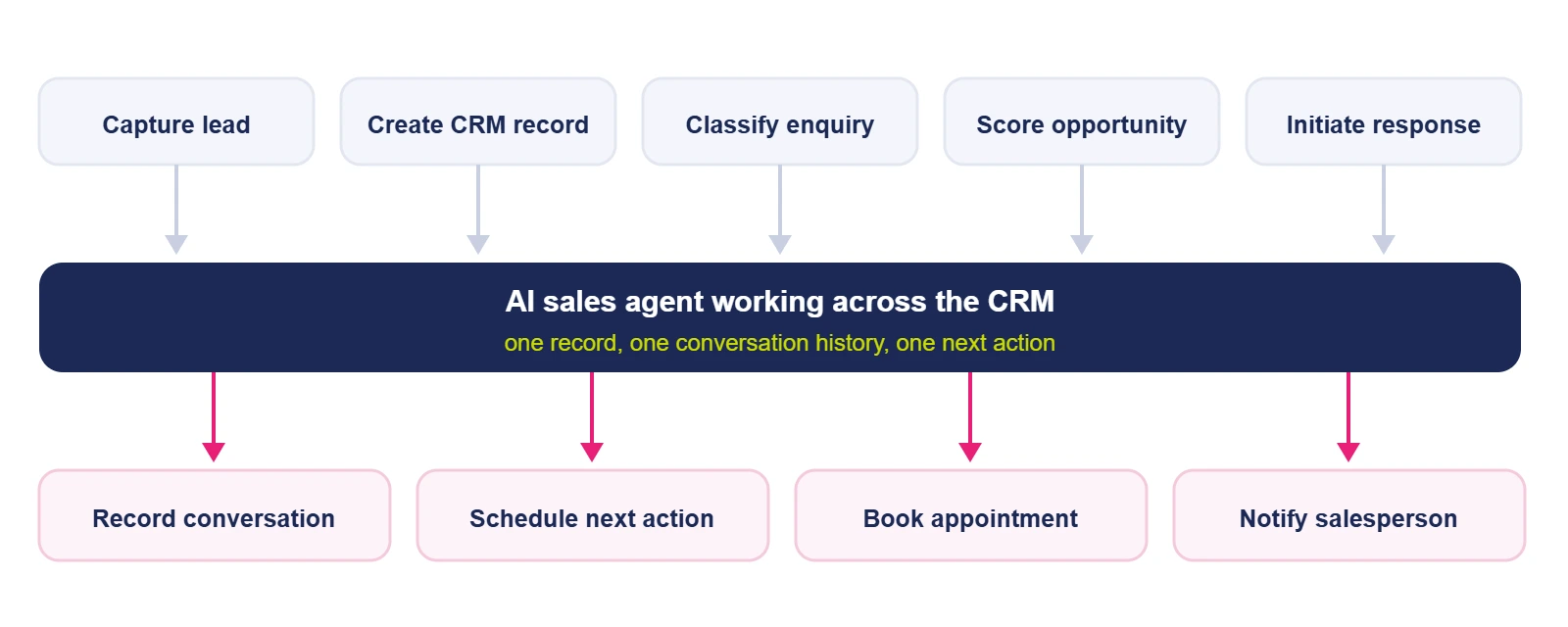
NextWeb OS, for example, combines AI automation with CRM workflows so that lead scoring, nurturing and follow-up actions can operate within the broader sales process.
This is an important distinction.
Adding an AI chatbot to a website is not the same as building an AI-powered sales system.
The real value appears when AI can take action across the sales stack.
6. AI Voice Agents Add Another Layer
Some sales conversations still work better over the phone.
This is where AI voice agents are becoming particularly interesting for sales operations.
Depending on the use case and applicable UAE regulations, an AI voice agent can assist with tasks such as:
- Responding to inbound enquiries
- Initial lead qualification
- Appointment scheduling
- Customer callbacks
- Lead routing
- Follow-up conversations
- Capturing information into the CRM
Imagine a prospect requesting a callback while your sales representatives are already handling other customers.
Instead of leaving the prospect waiting indefinitely, an AI-enabled workflow can help ensure the enquiry enters the correct follow-up process.
Human salespeople can then concentrate on conversations where negotiation, relationship building, judgement and closing expertise matter most.
7. Old Leads Can Become Opportunities Again
The most valuable AI sales opportunity may not be tomorrow’s leads.
It could be the thousands of contacts already sitting inside your CRM.
Most established businesses have leads labelled:
- No response
- Follow up later
- Quotation sent
- Not ready
- Lost
Some of those prospects may now be ready to buy.
AI-powered CRM automation can help businesses segment historical leads according to previous interactions, enquiry type, sales stage and other available data.
Appropriate prospects can then enter carefully designed re-engagement campaigns.
Instead of continuously paying to acquire new leads while ignoring existing ones, businesses can extract more value from the pipeline they have already built.
Why This Matters Particularly in the UAE
The UAE is moving aggressively toward AI-led operations.
In 2026, Dubai announced an initiative to transition its private sector toward Agentic AI, including specialised training through Dubai Chamber business councils and support for Agentic AI companies.
At the federal level, the UAE has also established a framework aimed at transforming 50% of government sectors, services and operations toward Agentic AI within two years.
Both sit within the wider UAE Strategy for Artificial Intelligence.
For UAE businesses, this signals something larger than the adoption of another software trend.
AI is increasingly moving from:
AI that answers → AI that acts.
Sales is one of the clearest places where that transition can create measurable commercial value, and it is where agentic AI automation tends to pay for itself first.
AI Sales Agents Do Not Mean Removing Your Sales Team
The strongest model is not necessarily AI versus humans.
It is AI plus humans.
AI is particularly well suited to repetitive, high-volume activities such as:
- Initial responses
- Basic qualification
- CRM updates
- Lead categorisation
- Follow-up reminders
- Appointment scheduling
- Lead routing
- Data collection
Human salespeople remain essential for:
- Complex negotiations
- Strategic discussions
- Relationship building
- Enterprise sales
- Objection handling
- Commercial judgement
- High-value closing
The goal is to stop experienced salespeople spending large portions of their day performing work that software can handle.
AI manages the repetitive mechanics.
Humans handle the moments that require trust, judgement and persuasion.
A Practical AI Sales Funnel for UAE Businesses
A modern AI-powered sales funnel could look like this:
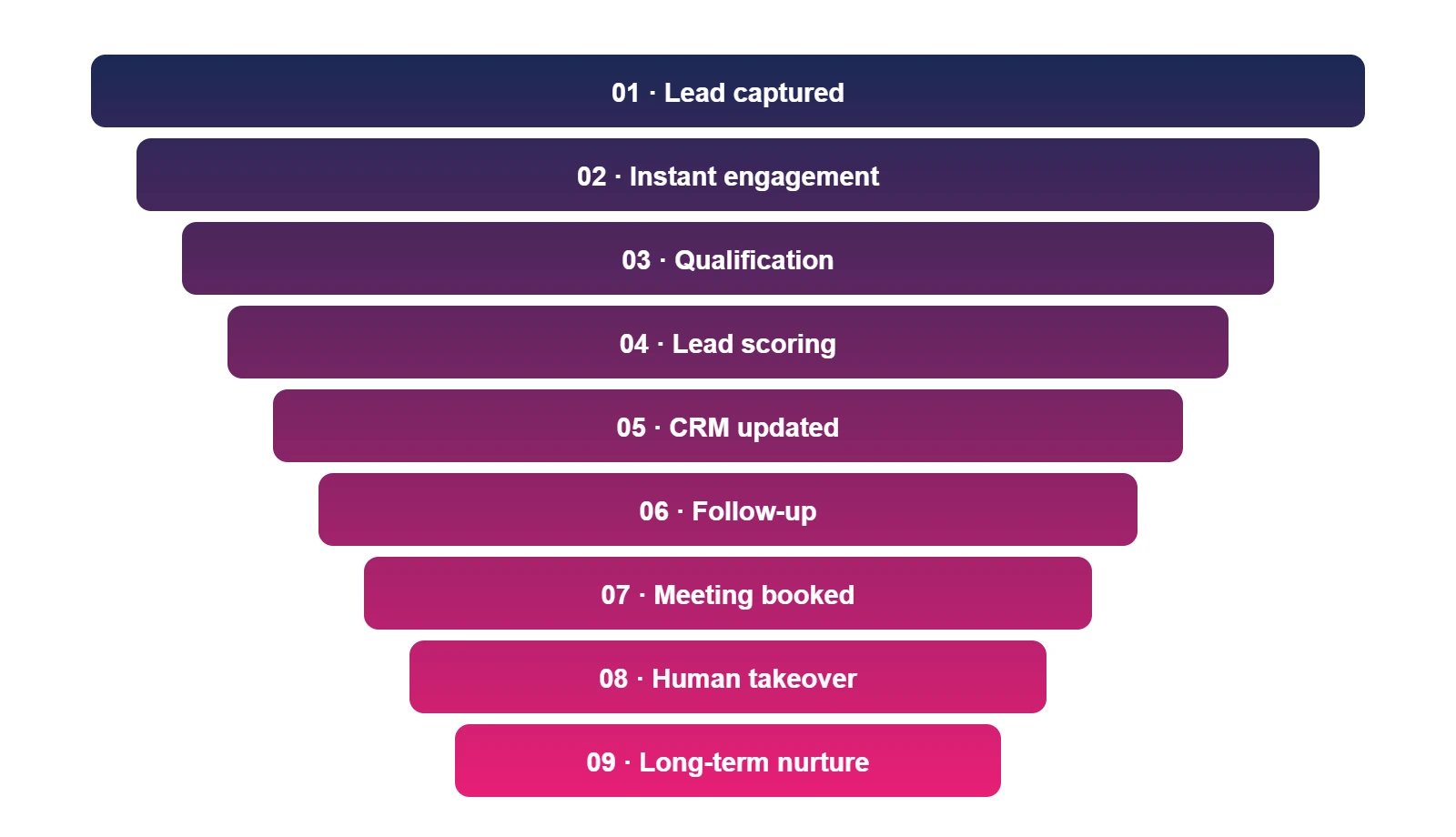
- 01Lead capturedA customer submits a website form, starts a chat or enters through another connected channel.
- 02Instant engagementThe AI sales agent responds and begins understanding the enquiry.
- 03QualificationRelevant questions establish requirements, urgency, location and buying intent.
- 04Lead scoringThe opportunity is prioritised according to the company’s sales criteria.
- 05CRM updatedContact details, conversation history and qualification information are recorded.
- 06Follow-upThe appropriate communication workflow continues based on the lead’s stage.
- 07Meeting bookedQualified prospects are directed toward an appointment or salesperson.
- 08Human takeoverThe sales representative receives the context and continues the conversation.
- 09Long-term nurtureProspects who are not ready today remain in an appropriate follow-up process.
This is how AI sales automation can turn a collection of disconnected tools into a more continuous revenue engine.
Compliance Still Matters
AI does not remove a company’s regulatory responsibilities.
This is particularly important when businesses use automated calling or telemarketing.
UAE telemarketing regulations include requirements relating to company approval, permitted calling practices, local telephone numbers registered under the company’s commercial licence, the Do Not Call Registry (DNCR), and record keeping.
Businesses implementing AI calling or automated outreach should therefore build compliance into the system from the beginning rather than treating it as an afterthought. This is one of the areas where AI consulting in the UAE earns its place before a single workflow goes live.
The objective should be responsible automation, not simply maximum automation.
The Real Question: How Many Leads Are You Already Losing?
Before investing more money into lead generation, UAE businesses should examine what happens to the leads they already generate.
Ask:
- How quickly do we respond?
- How many enquiries never receive a second follow-up?
- How many quotations receive no further contact?
- How many “call me later” prospects are actually called later?
- How many leads sit untouched inside our CRM?
- How many enquiries arrive outside business hours?
- How much time does our sales team spend updating systems instead of selling?
The answers reveal where AI sales agents can create the most immediate value.
Turn Your Sales Pipeline Into an AI-Powered Revenue System
The next stage of sales automation is not about sending more automated emails.
It is about creating a connected system capable of understanding leads, determining the next action and keeping opportunities moving.
NextWeb OS helps UAE businesses build AI-powered sales operations combining intelligent CRM, AI agents, lead scoring, automated workflows and sales automation.
Whether you are dealing with hundreds of enquiries or building an enterprise sales pipeline, the objective remains the same:
Respond faster. Follow up consistently. Prioritise better. Lose fewer opportunities.
Because the most expensive lead is often not the one you failed to generate.
It is the one you already paid for and forgot to follow up.
Frequently Asked Questions
What is an AI sales agent?
An AI sales agent is an intelligent software system that can perform sales-related tasks such as responding to enquiries, qualifying prospects, updating CRM records, following up with leads and scheduling appointments. More advanced agents can make contextual decisions and complete multi-step workflows.
Can AI sales agents follow up with leads automatically?
Yes. AI sales agents can trigger follow-ups based on CRM status, previous conversations, lead behaviour and business-defined rules. The workflow should be designed around the communication channel being used and relevant privacy and marketing requirements.
Can AI sales agents integrate with a CRM?
Yes. CRM integration is one of the most useful applications of AI sales automation. An agent can potentially create records, update lead stages, add conversation notes, trigger workflows and notify salespeople when human attention is required.
Are AI sales agents suitable for small businesses in the UAE?
They can be. SMEs with high enquiry volumes can use AI to reduce repetitive sales administration and improve response consistency without necessarily increasing administrative headcount at the same rate as lead volume.
Will AI replace salespeople?
AI is more useful as a sales force multiplier than as a complete replacement for human salespeople. AI can handle repetitive qualification, follow-up and administrative work while humans concentrate on relationships, negotiation and closing.
Are AI sales calls legal in the UAE?
Businesses using automated or AI-enabled calling need to consider UAE telemarketing requirements. UAE regulations govern areas including prior approval for telemarketing activity, local business-registered numbers, DNCR requirements and call records. Businesses should assess their specific use case for regulatory compliance before deployment.